
AI and the policy machine
Why funders should embrace complexity to tackle AI’s socioeconomic risks
By Andrew Whitten — Spring ‘26 Policy Leaders Programme Alumni
Note: The views and opinions expressed in this policy paper are those of the author(s) and do not necessarily reflect the official policy or position of Talos Network.
After work in other policy areas, two things struck me when looking at AI’s systemic socioeconomic risks:
The urgency is new. Careful, credible people are warning of capabilities which could pose systemic risks to economies, societies and international relations on the scale of climate change, but potentially much quicker timelines (Hobbs et al., 2026).
The policy machine addressing these risks is familiar. The structures of governments and NGOs mirror those which have taken decades to deliver comprehensive action on similarly crosscutting issues.
That’s striking because in MIT’s recent expert survey, around half of the ten risks judged most likely to produce catastrophic outcomes were socioeconomic & environmental (Saeri et al., 2026). Why are we approaching risks this serious with the same policy infrastructure that failed to deliver rapid results on comparable challenges?
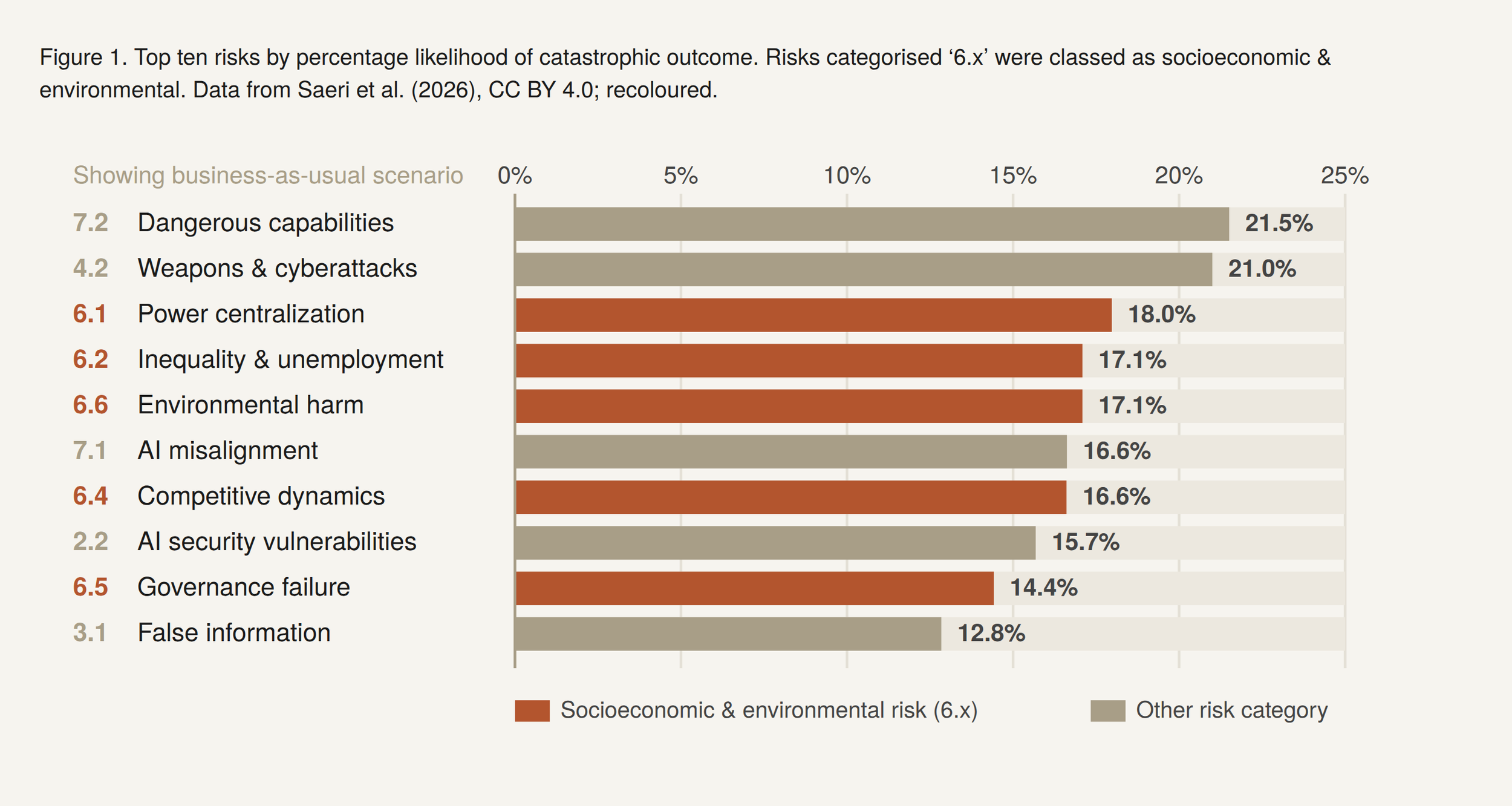
Figure 1. Top ten risks by percentage likelihood of catastrophic outcome. Risks categorised ‘6.x’ were classed as socioeconomic & environmental. Data from Saeri et al. (2026), CC BY 4.0; recoloured.
A key reason is that current funding strategies process both AI’s deep, technical risks and broad, crosscutting ones through a single machine. Regardless of category, the most severe risks get broken down into smaller chunks until they appear independent, easy to measure and quick to deliver against. For crosscutting risks, this is like trying to understand a book by defining each word in isolation. It might feel simpler, but it just relocates the complexity, dropping the ball as things get most difficult — when someone has to map the interactions of individually good ideas and turn them into a cohesive, deliverable plan.
Consciously or not, we are building a one-size-fits-all approach, well suited to tackling AI’s technical risks, repeatedly proven unfit to address crosscutting socioeconomic ones. This isn’t inevitable — governments, NGOs, and especially funders, have a unique and short-lived opportunity to change tack and shift the incentives and structures for socioeconomic risks. This note aims to describe why that change is necessary, and what it could look like in practice.
The integration bottleneck
As others have noted, AI’s socioeconomic risks are an archetypal ‘super wicked problem’ — crosscutting, urgent, lacking any central owner, with the actors causing the problem also offering its solutions. This category was coined for climate change, where comparable dynamics meant action took more than 20 years from the 1992 Rio framework to the Paris Agreement (Levin et al., 2012; Gruetzemacher, 2018).
The UK’s AI Opportunities Plan provides an example of the challenge. It includes around 50 actions of the sort needed to prepare middle powers for a world with transformative AI. Delivering it in full would require the coordinated action of 30 public bodies, including 15 departments.
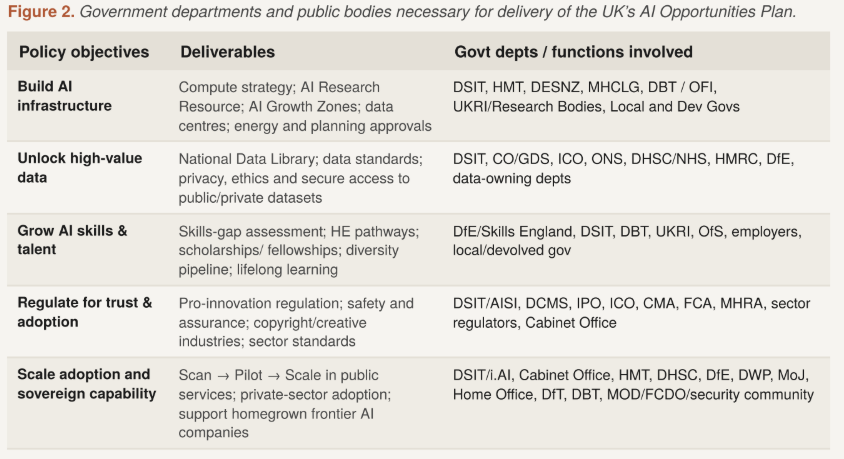
Figure 2. Government departments and public bodies necessary for delivery of the UK’s AI Opportunities Plan.
Developing individual proposals is hard, but the work required scales linearly with complexity. The work of integration (Fig. 3) — turning these independent proposals into coherent policy — grows with the interactions between proposals, and interactions accumulate far faster than proposals do.
This policy integration challenge has tended to be left to governments, who already hold the breadth of expertise needed. Unfortunately, governments also have a severe structural handicap when it comes to integration, because of their reliance on creative tension to produce balanced policies. Even if it’s clear which government department owns a risk (it often isn’t), crosscutting risks by definition involve policy interventions and levers owned by another.
A science department might be best equipped to spot AI’s risks, for example, and responsible for addressing them, but accessing the expertise needed even to map a proposed mitigation’s trade-offs first requires negotiation with departments deliberately designed to have other priorities. The wider that negotiation spreads, the harder integration becomes — each additional department brings its own priorities, worldview and level of understanding of the technology, all of which must be reconciled before the trade-offs themselves can be grappled with.
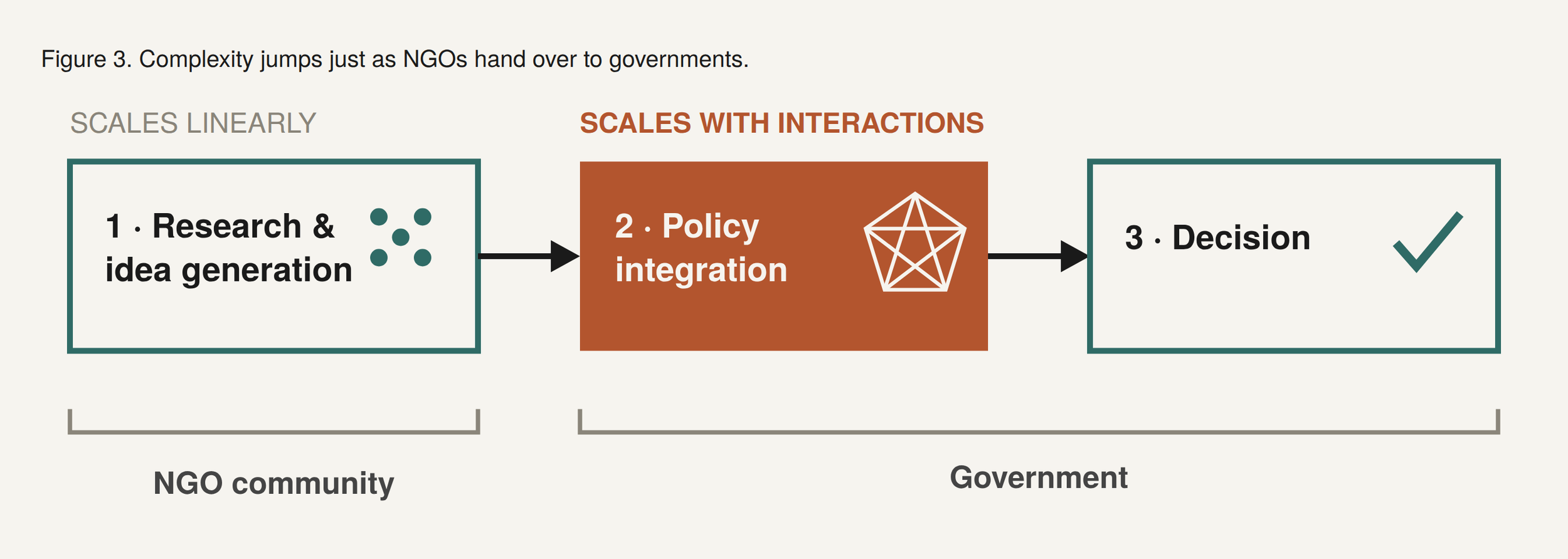
Figure 3. Complexity jumps just as NGOs hand over to governments.
The effects of this handicap can already be seen in AI policy. Compared to technical risk mitigations, which can often be delivered within a single department’s competence, work on cross-sectoral socioeconomic challenges is lagging (MIT AI Risk Initiative, 2026). France’s own audit of its national strategy found the research & infrastructure pillars largely delivered, while other cross-domain pieces fell behind (Cour des comptes, 2025). And multiple papers have demonstrated that, even where the EU has implemented AI policies, you would struggle to call the overall policy package ‘coherent’ (The Future Society, 2026a, 2026b).
Case study: where the current machine works — frontier model evaluations
Frontier model evaluation shows the parallel-bets model operating as designed.
The field is built on small, specialised teams — independent evaluators, academic benchmark groups, non-profits tracking compute and capabilities — often funded through small-to-mid sized philanthropic grants, and each producing work that stands alone.
No one would say the job is done, but their outputs were integrated quickly and impressive progress has been made. Evaluations now feed the safety frameworks frontier labs adopted from 2023, the Frontier AI Safety Commitments made at Seoul in 2024, the EU’s GPAI Code of Practice, and joint pre-deployment testing by national institutes.
Part of what made such rapid progress possible was decision makers — primarily AI labs — who directly owned the levers needed to implement their decision. What integration was necessary happened within single or small groups of organisations, with shared context.
The gap
If precedent and current progress both show complex, socioeconomic policies stalling at integration, why hasn’t this been addressed? In AI policy, I suggest it’s because prior success on technical risks, and an understandable desire to fund quick, measurable work, creates an incentive to treat each risk as an independent, siloed challenge.
In practice, this means risks needing many parallel technical bets and risks needing cross-vertical integration are funded through identical instruments: small-to-mid sized philanthropic project grants for tightly scoped teams.
Longview’s power-concentration programme illustrates the pattern: having named a quintessentially crosscutting risk, it decomposes the work into twelve priority areas and funds each as a separate project (Longview Philanthropy, 2026). Humanity AI spreads its five verticals through member foundations’ separate pathways (MacArthur Foundation, 2025). Funders aren’t incentivising the new policy structures — or types of organisation — that are needed to effectively manage crosscutting socioeconomic risks.
Instead, every new fund tries to reduce complexity and interdependencies, rather than recognising these as the bottleneck to be confronted. The job of integration defaults, again, to government, and the functional gap worsens even as more topics are addressed.
A double-edged sword
Against this backdrop, one crucial difference may give AI a better chance of policy success: philanthropic funding is running unusually far ahead of the sector’s ability to spend it. Combined with a sense of urgency, this gap should create an appetite for new approaches to the policy process.
This mismatch also presents a risk. Philanthropic pressure for more capacity rewards fragmentation. For technical risks that may be no bad thing — a funder facing deep uncertainty wants many parallel, independent bets to hedge across. But the same setup is corrosive for action on socioeconomic risks, because increasing the number of aligned-but-different voices and proposals just makes the integration bottleneck worse.
Between ideas and implementation
Instead of growing more capacity where it already exists, funders should address the bottleneck that sits between ideas and implementation, by incentivising NGOs to expand their focus into the integration layer.
It’s not that NGOs are better suited to this because they hold more expertise than governments; plainly they don’t. Their unique value is an ability to bring broad expertise together under a single mission.
Almost nothing like this currently exists — organisations like the Tony Blair Institute combine broad expertise with broad objectives, while many in the AI space leverage narrow expertise to produce excellent but equally narrow proposals.
We urgently need NGOs able to bring broad expertise — including from outside AI — to bear on a tight objective, e.g. concentration of power. By mapping and testing the trade-offs in advance, it would focus politicians on the one thing they alone must do — decide which compromises to make.
Case study & counterfactual: the UK’s AI Growth Zones
AI Growth Zones were aimed at speeding up deployment of large scale AI infrastructure like data centres, and they’re a good illustration of the integration bottleneck.
As originally proposed, they were a single-vertical fix: fast-tracked planning and grid access to get compute built. But success depended on trade-offs that weren’t packaged with the proposal. In energy, grid connections were limited by a theoretical ~400GW connection queue for the London area alone. In planning and local legitimacy, delivery leant on reforms removing residents’ right to object. And the question of who pays for the data centre’s discounted electricity bill wasn’t confronted.
This cross-domain work wasn’t done up front; it was left to government. A year on, the first site in Oxfordshire had not begun building — and a new Energy Council was working with Ofgem and NESO on grid connection reform (DSIT, 2026).
Now imagine the same proposal passed through an organisation built to do that integration before it reached a minister. It doesn’t make the hard choices disappear, but the proposal is presented with trade-offs made explicit and potential compromises outlined.
Rather than “fast-track planning and power,” the Growth Zone proposal arrives as one reconciled package containing a use-it-or-lose-it rule to clear the speculative grid queue; a plan for community-benefit and consent; an explicit position on whether and how consumers are exposed to the cost; and access conditions on anchor tenants, so a sovereignty measure doesn’t quietly entrench two or three hyperscalers.
The politicians still have to choose — but it becomes an informed choice leading directly to implementation, with the integration burden lifted in advance by parties (NGOs and funders) most invested in quick delivery.
Conclusion
Funding strategies are the dominant force shaping the AI policy machine and the NGO/government relationship. Until they embrace complex policy integration as a core component of socioeconomic risk mitigation, I think we are likely to rebuild an approach that succeeds for technical risks and struggles to achieve impact elsewhere.
Changing this approach could take different forms:
Shifting incentives for existing organisations, for example specifying that research or proposals should consider interactions with adjacent policy areas, or asking for reports to be stress-tested by specialists from fields outside of AI. Funders could also target grants at expert groups outside of AI, encouraging new perspectives on its socioeconomic risks.
Building new capability, through schemes which embed AI expertise within established energy, labour or competition organisations, or the reverse.
Building new structures, e.g. NGOs focussed specifically on AI policy integration for a particular socioeconomic risk.
While funders hold most of the cards, other players also have agency. NGOs could prioritise partnerships with outside groups, and governments should signal their openness to others taking on some of the integration burden.
I can’t prove this shift would speed progress, but the standard approach has an ample record of not delivering quickly enough — and there is strong evidence, theoretical and empirical, to suggest that governments approach integration with a structural handicap NGOs wouldn’t share.
For me, that’s enough reason to try. But if you’re a funder, at an NGO or in government and disagree, I’d love to hear from you. Feel free to reach out on LinkedIn.
References
Cour des comptes (2025) La stratégie nationale pour l’intelligence artificielle : consolider les succès de la politique publique de l’IA, élargir son champ, rapport public thématique, 19 November. https://www.ccomptes.fr/sites/default/files/2025-11/20251119-synthese-Strat%C3%A9gie-nationale-IA.pdf
Department for Science, Innovation and Technology (2026) AI Opportunities Action Plan: One Year On, 29 January. https://www.gov.uk/government/publications/ai-opportunities-action-plan-one-year-on
Gruetzemacher, R. (2018) ‘Rethinking AI Strategy and Policy as Entangled Super Wicked Problems’, Proceedings of the 2018 AAAI/ACM Conference on AI, Ethics, and Society (AIES ’18), p. 122. https://doi.org/10.1145/3278721.3278746
Hobbs, H., Docherty, D., Aranda, L., Perset, K., Sugimoto, K. and Kierzenkowski, R. (2026) ‘Exploring possible AI trajectories through 2030’, OECD Artificial Intelligence Papers No. 55, OECD Publishing, Paris. https://doi.org/10.1787/cb41117a-en
Levin, K., Cashore, B., Bernstein, S. and Auld, G. (2012) ‘Overcoming the tragedy of super wicked problems: constraining our future selves to ameliorate global climate change’, Policy Sciences, 45(2), pp. 123–152.
Longview Philanthropy (2026) Request for Proposals on Extreme Power Concentration. https://www.longview.org/request-for-proposals-on-extreme-power-concentration/
MacArthur Foundation (2025) Humanity AI Commits $500 Million to Build a People-Centered Future for AI, press release, 14 October. https://www.macfound.org/press/press-releases/humanity-ai-commits-500-million-to-build-a-people-centered-future-for-ai
MIT AI Risk Initiative (2026) Mapping the AI Governance Landscape: April 2026 Update, 9 April. https://airisk.mit.edu/blog/mapping-the-ai-governance-landscape-april-2026-update
Saeri, A. et al. (2026) Prioritization of Risks from AI, MIT FutureTech / MIT AI Risk Initiative. https://airisk.mit.edu/priorities
The Future Society (2026a) Beware of Geeks Bearing Gifts: Building True EU Frontier AI Sovereignty, April. https://thefuturesociety.org/eu-frontier-ai-sovereignty-report/
The Future Society (2026b) Europe’s AI Strategy: Mapping the EU’s Emerging AI Policy Portfolio, March. https://thefuturesociety.org/mapping-europes-emerging-ai-policy-strategy
